If you’ve been researching solar panels, you may have come across a surprisingly simple question:
What is the 33% rule in solar panels?
The problem is that the phrase “33% rule” doesn’t always mean the same thing.
In one context, 33% refers to a fundamental theoretical limit for a conventional single-junction solar cell. The U.S. Department of Energy puts that limit at about 33.5% under non-concentrated sunlight, a concept known as the Shockley-Queisser limit.
In another context, 33% appears in rooftop solar fire-code requirements. Under the International Residential Code, for example, photovoltaic arrays occupying no more than 33% of the roof’s plan-view area have different ridge setback requirements from arrays occupying more than 33%.
So if someone tells you, “Solar panels have a 33% rule,” the natural follow-up should be:
“Which 33% rule?”
Let’s break down both meanings, why they exist, and what they actually mean for a homeowner considering or already using solar.
What Is the 33% Rule?
There isn’t one universal solar regulation officially called “the 33% rule.”
The term is commonly used to describe two very different concepts:
- The approximately 33% theoretical efficiency limit for single-junction solar cells
- A 33% rooftop-array threshold used in certain fire and building-code provisions
The first is about physics and solar cell efficiency.
The second is about roof layout, firefighter access, and fire safety.
Confusing these two can lead to completely different conclusions about what you’re allowed to install and how efficiently your solar panels can operate.
1. The 33% Solar Efficiency Limit
Let’s start with the version most closely connected to the actual science of solar panels.
A solar cell doesn’t convert every bit of sunlight that hits it into electricity.
There are fundamental physical losses.
The sunlight reaching Earth contains photons with different energy levels. A conventional single-junction photovoltaic cell is designed around a particular semiconductor band gap. Photons below that energy threshold may not be absorbed, while photons carrying substantially more energy than the band gap can lose some of their excess energy as heat.
The U.S. Department of Energy explains that these fundamental losses contribute to a theoretical efficiency limit of around 33%, known as the Shockley-Queisser limit.
This is why the phrase sometimes appears in searches such as:
- What is the 33% efficiency limit for solar panels?
- Why can’t solar panels be 100% efficient?
- What is the maximum efficiency of a solar cell?
- Why are solar panels only about 20% efficient?
- What is the Shockley-Queisser limit?
- Can solar panels exceed 33% efficiency?
- Is 33% the maximum efficiency of solar panels?
The important detail is that 33% is not the efficiency rating of your rooftop solar panel.
It is a theoretical benchmark for an idealised single-junction solar cell under specified conditions.
Why Can’t Solar Panels Convert 100% of Sunlight Into Electricity?
This is where the subject gets fascinating.
It might seem logical that better solar technology should eventually capture nearly all the sunlight falling on a panel.
But photovoltaic conversion isn’t simply a matter of making the glass cleaner or adding more cells.
The physics of light itself creates losses.
Some photons don’t have enough energy
A semiconductor can only absorb photons that meet the energy requirements associated with its band gap.
Lower-energy photons can pass through without generating useful electrical energy.
Some photon energy becomes heat
A photon can arrive carrying more energy than the solar cell needs to create an electron-hole pair.
The excess energy doesn’t simply become additional electricity.
Much of it is lost as heat.
Electrical losses also occur
Even after sunlight creates charge carriers, they still have to be collected and transported through the solar cell and electrical system.
Resistance, recombination and other mechanisms reduce the amount of energy that ultimately becomes usable electricity.
These are some of the reasons the theoretical single-junction ceiling is around 33%.
Does That Mean Today’s Solar Panels Are Only 33% Efficient?
No.
And this is one of the biggest misunderstandings surrounding the 33% figure.
The 33% number is a theoretical ceiling, not the normal performance rating printed on a residential solar panel.
Modern solar technology continues to improve, but commercial rooftop modules generally operate below the theoretical single-junction limit.
There is also an important distinction between cell efficiency and module efficiency.
A laboratory solar cell may achieve a higher efficiency than a complete commercial panel because a finished module includes additional components and real-world losses.
So when comparing solar panels, don’t look at the 33% figure and conclude that a 20%-plus panel is somehow “missing” 13 percentage points that should be available.
The two numbers describe different things.
Can Solar Panels Go Beyond the 33% Limit?
Yes, but there’s an important catch.
The approximately 33.5% Shockley-Queisser limit applies to a single-band gap solar cell under non-concentrated sunlight.
It does not mean every conceivable photovoltaic technology is permanently capped at 33%.
For example, multi-junction solar cells use multiple semiconductor materials with different band gaps. Instead of asking one material to absorb a broad range of sunlight, multiple junctions can capture different portions of the solar spectrum more effectively.
The Department of Energy notes that high-efficiency multi junction devices have achieved efficiencies above 45%, while research institutions have reported even higher laboratory results under specialised conditions.
That’s why you may see headlines about solar cells exceeding 33%.
There is no contradiction.
The technology has changed.
The theoretical limit being discussed has changed too because the underlying assumptions are different.
2. The Other “33% Rule”: Rooftop Solar Coverage
Now we reach the second meaning of the phrase.
This one has nothing to do with photovoltaic efficiency.
It’s about where solar panels can be placed on a roof.
Certain building and fire codes use a 33% threshold when determining rooftop PV ridge setbacks.
For example, the 2024 International Residential Code states that when a photovoltaic array occupies 33% or less of the plan-view total roof area, an 18-inch clear setback is required on both sides of a horizontal ridge. When the array occupies more than 33%, the required ridge setback increases to 36 inches.
The International Fire Code contains a similar provision.
California’s 2025 Fire Code also contains this 33% threshold for ridge setbacks.
This is where things can become confusing for homeowners.
Someone may say:
“You can only cover 33% of your roof with solar panels.”
That’s not an accurate universal statement.
The code language is more nuanced.
The 33% threshold affects specific setback requirements, rather than simply creating a universal prohibition against installing more than 33% of the roof with solar.
And local requirements can vary depending on the jurisdiction, building type, roof configuration, fire-code adoption and applicable exceptions.
Why Does the 33% Roof Rule Exist?
The reason is safety.
Imagine firefighters arriving at a house during a roof fire.
They need space to:
- Access the roof
- Move safely
- Ventilate the structure
- Navigate around rooftop equipment
- Reach important areas
- Perform emergency operations
A roof covered wall-to-wall with photovoltaic modules can make those operations more difficult.
That’s why rooftop solar codes incorporate pathways and clearances.
The International Residential Code, for example, requires roof pathways designed to provide firefighter access and specifies clearances around ridges.
So this version of the “33% rule” isn’t about protecting your solar panels.
It’s about protecting people during an emergency.
Does the 33% Rule Mean You Can Only Install Solar on One-Third of Your Roof?
Not necessarily.
This is an important distinction.
The 33% threshold in the code provisions we examined is tied to specific setback requirements.
For example, under the 2024 IRC:
| PV array coverage | Ridge setback |
| 33% or less | 18 inches |
| More than 33% | 36 inches |
The code also contains an alternative provision for certain homes with automatic sprinkler systems, where the threshold can be 66% rather than 33%.
That means you shouldn’t calculate your available roof space and simply say:
“I can only install panels on 33% of it.”
A qualified solar installer and the authority having jurisdiction need to evaluate the actual roof layout and applicable code requirements.
What Is the 33% Rule for Solar Panels in California?
For California homeowners, this question deserves special attention.
California’s current fire-code provisions include the 33% threshold for photovoltaic arrays and ridge setbacks. The 2025 California Fire Code, Title 24, Part 9, specifies an 18-inch setback for arrays occupying 33% or less of the plan-view roof area and a 36-inch setback when the array exceeds 33%. It also provides an alternative threshold of 66% in certain sprinklered dwelling situations.
However, solar permitting isn’t something homeowners should calculate from a generic internet rule alone.
Your installer needs to account for the specific roof design, pathways, equipment, local permitting requirements and applicable code edition.
For a homeowner in California, this can affect the number and arrangement of panels that fit on a particular roof.
Why the 33% Rule Matters When Designing a Solar System
Suppose you have a large roof and want to maximize your solar capacity.
You might assume:
More available roof = more panels = more electricity.
Not always.
A solar designer has to balance several factors:
- Roof orientation
- Roof pitch
- Shade
- Panel efficiency
- Fire pathways
- Ridge setbacks
- Roof penetrations
- Electrical equipment
- Structural considerations
- Local permitting rules
This means the largest possible number of panels isn’t automatically the best solar design.
A smaller but better-positioned array can sometimes outperform a larger array affected by shade or poor orientation.
What About Solar Panel Efficiency, Temperature and Dirt?
Here’s where the 33% efficiency discussion connects with something homeowners can actually control.
Even if a solar panel has an excellent rated efficiency, its real-world energy production can be affected by operating conditions.
Heat is one example.
Solar panels generally don’t become more productive simply because the sun gets hotter. In fact, photovoltaic module output typically declines as cell temperature rises.
Then there is something much simpler:
Dirt.
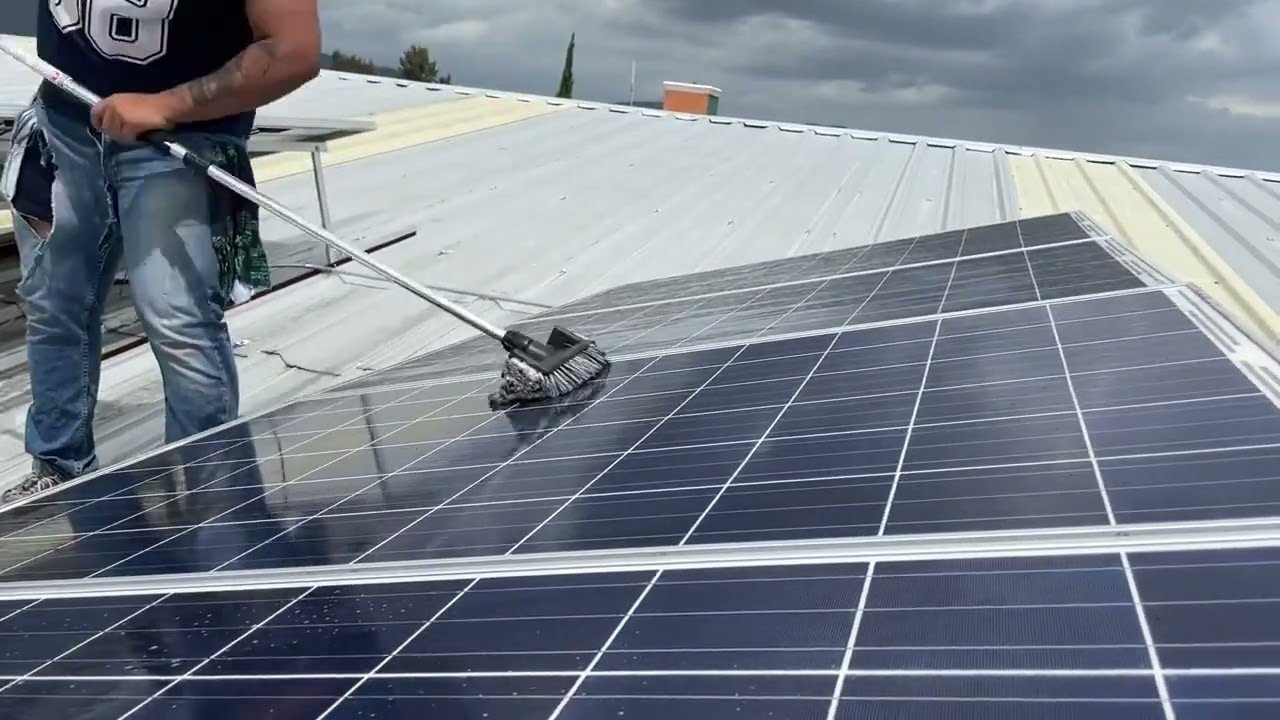
Dust, pollen, bird droppings, leaves and other debris can reduce the amount of sunlight reaching the photovoltaic surface.
This doesn’t change the theoretical Shockley-Queisser limit.
It affects how much of the available sunlight your installed system can actually use.
That’s why it’s useful to distinguish between:
Theoretical efficiency → what photovoltaic physics permits under defined assumptions.
Rated module efficiency → how efficiently the module converts sunlight under standardized test conditions.
Real-world energy production → what your system actually produces on your roof.
Those are three different measurements.
Does Cleaning Solar Panels Increase Their Efficiency?
Not in the sense of changing the panel’s rated efficiency percentage.
Cleaning doesn’t transform a 20% efficient module into a 25% efficient module.
Instead, cleaning can help remove material that blocks sunlight from reaching the photovoltaic cells.
The practical question is therefore not:
“Can cleaning change my panel’s efficiency rating?”
It’s:
“Are dirt and debris reducing the amount of sunlight reaching my panels?”
The answer depends heavily on your location and conditions.
Homes near dusty roads, agricultural areas, construction, trees or heavy bird activity may accumulate debris more quickly than homes in cleaner environments.
This is why a blanket rule such as “clean solar panels every six months” isn’t appropriate for every property.
How Often Should Solar Panels Be Cleaned?
There isn’t one universal schedule.
Instead, inspect your panels and consider the environment around your home.
You may need more frequent attention if your property has:
- Heavy dust
- Lots of trees
- High pollen
- Frequent bird activity
- Nearby construction
- Agricultural activity
- Long dry periods
- Significant air pollution
- Persistent grime after rain
You should also pay attention to your system’s production data.
If your solar monitoring system shows an unexplained decline in production, don’t immediately assume dirty panels are responsible.
Possible causes include:
- Shade changes
- Inverter problems
- Equipment faults
- Wiring issues
- Weather differences
- Panel degradation
- Utility interruptions
A proper diagnosis is better than simply cleaning the panels and hoping the problem disappears.
Is the 33% Rule Related to Solar Panel Cleaning?
No.
This is another misconception worth clearing up.
The two 33% concepts we’ve discussed have nothing directly to do with cleaning.
The 33% efficiency figure relates to the theoretical performance limit of a single-junction photovoltaic cell.
The 33% roof-area threshold relates to rooftop PV layout and fire-code setback requirements.
Neither one says:
“Clean your solar panels when they reach 33% dirt.”
There is no standard solar-maintenance rule like that.
33% Solar Rule: Common Myths vs. Facts
Myth: Solar panels can only be 33% efficient.
Fact: Around 33.5% is the theoretical limit for a single-band gap solar cell under non-concentrated sunlight. Other photovoltaic architectures, such as multi junction cells, can exceed it.
Myth: You can never put solar panels on more than 33% of your roof.
Fact: The 33% figure appears in specific code provisions governing ridge setbacks. It is not a universal rule that simply bans solar arrays above 33% roof coverage.
Myth: The 33% rule is a federal solar law.
Fact: The efficiency limit is a physics concept, while rooftop 33% thresholds come from applicable building/fire-code provisions. They’re fundamentally different things.
Myth: Cleaning solar panels makes them exceed the 33% efficiency limit.
Fact: Cleaning can remove dirt and debris that obstruct sunlight, but it doesn’t change the fundamental efficiency limit of the photovoltaic technology.
Myth: A panel’s advertised efficiency tells you exactly how much electricity your roof will produce.
Fact: Actual production depends on sunlight, temperature, orientation, shading, system design, equipment, soiling and other real-world factors.
What Should Homeowners Actually Pay Attention To?
If you’re considering solar, don’t get trapped in a single percentage.
Instead, ask your installer these questions:
1. What is the panel’s rated efficiency?
This tells you how effectively the module converts sunlight under standardized test conditions.
2. How much electricity should this system produce annually?
This is more useful than looking at panel efficiency alone.
3. How much roof area will the array occupy?
Your installer should explain how fire pathways and setbacks affect the layout.
4. What local code requirements apply?
Don’t assume a rule from another state or city applies to your property.
5. How will shading affect production?
A highly efficient panel in shade can still produce less energy than a lower-rated panel receiving unobstructed sunlight.
6. How should the panels be maintained?
Ask about inspection, cleaning and monitoring.
7. What does the production warranty cover?
Understand the difference between equipment warranties and performance guarantees.
The Bigger Picture: Solar Efficiency Is About More Than One Number
The 33% figure is useful because it explains something fundamental about photovoltaic technology.
But it shouldn’t become a shortcut for evaluating an entire solar system.
A homeowner doesn’t buy a theoretical efficiency limit.
They buy a system that needs to perform on a specific roof, under specific weather and shading conditions, for many years.
That means the real-world questions are more practical:
How much electricity will my system generate?
How much of that electricity will my household use?
How much will I export to the grid?
How will temperature and shading affect production?
How will the panels be maintained?
And how much will the system save over its useful life?
Those questions are far more meaningful than simply asking whether your panels are close to 33% efficient.
Final Takeaway: So, What Is the 33% Rule in Solar Panels?
The phrase “33% rule” can refer to two completely different things.
The first is the Shockley-Queisser limit, which places the theoretical efficiency of an ideal single-junction solar cell at roughly 33.5% under non-concentrated sunlight. It exists because of fundamental losses in converting the Sun’s broad spectrum into electricity.
The second is a rooftop PV coverage threshold used in certain building and fire codes. In the International Residential Code and related provisions, arrays occupying 33% or less of the plan-view roof area have different ridge setback requirements from arrays occupying more than 33%.
Neither meaning is a universal rule that says your solar panels can only be 33% efficient or that you can only cover exactly one-third of your roof.
If you’re planning a rooftop solar installation, the safest approach is to have your installer evaluate your roof against the currently adopted local code, rather than relying on a generic “33% rule” found online.
And if you already have solar, focus less on the number 33 and more on the things that determine your actual production: sun exposure, shading, temperature, system design, equipment condition, monitoring and panel cleanliness.
Frequently Asked Questions
Is 33% the maximum efficiency of a solar panel?
Not exactly. Approximately 33.5% is the theoretical Shockley-Queisser limit for an ideal single-junction solar cell under non-concentrated sunlight. Multi-junction technologies can exceed this limit.
What is the 33% rule for solar panels on a roof?
In certain building and fire-code provisions, 33% is a threshold used to determine rooftop PV ridge setback requirements. It does not universally mean that solar panels are prohibited from covering more than 33% of a roof.
Why is solar panel efficiency limited to about 33%?
The single-junction limit comes from fundamental photovoltaic losses, including the inability to efficiently use all photon energies and losses associated with excess photon energy.
Can solar cells exceed 33% efficiency?
Yes. Multi-junction solar cells use multiple band gaps to capture different portions of the solar spectrum and can achieve efficiencies substantially above the single-junction limit.
Does cleaning solar panels improve their efficiency?
Cleaning doesn’t change the panel’s rated efficiency or the theoretical 33% limit. It can, however, remove dirt and debris that obstruct sunlight and potentially reduce real-world energy production.
Is the 33% solar rule the same in every state?
No. Rooftop solar requirements depend on the building and fire codes adopted by the relevant jurisdiction, along with the applicable code edition and exceptions. California, for example, has its own current Title 24 provisions.